
Crack Sealing & Crack Repair in Austin, TX
Stop water before it turns hairline cracks into base failure. Hot-applied, FHWA-spec crack sealing for Austin commercial properties.
Request a quick quote
Tell us about your property. We'll respond within one business day.
What is crack sealing?
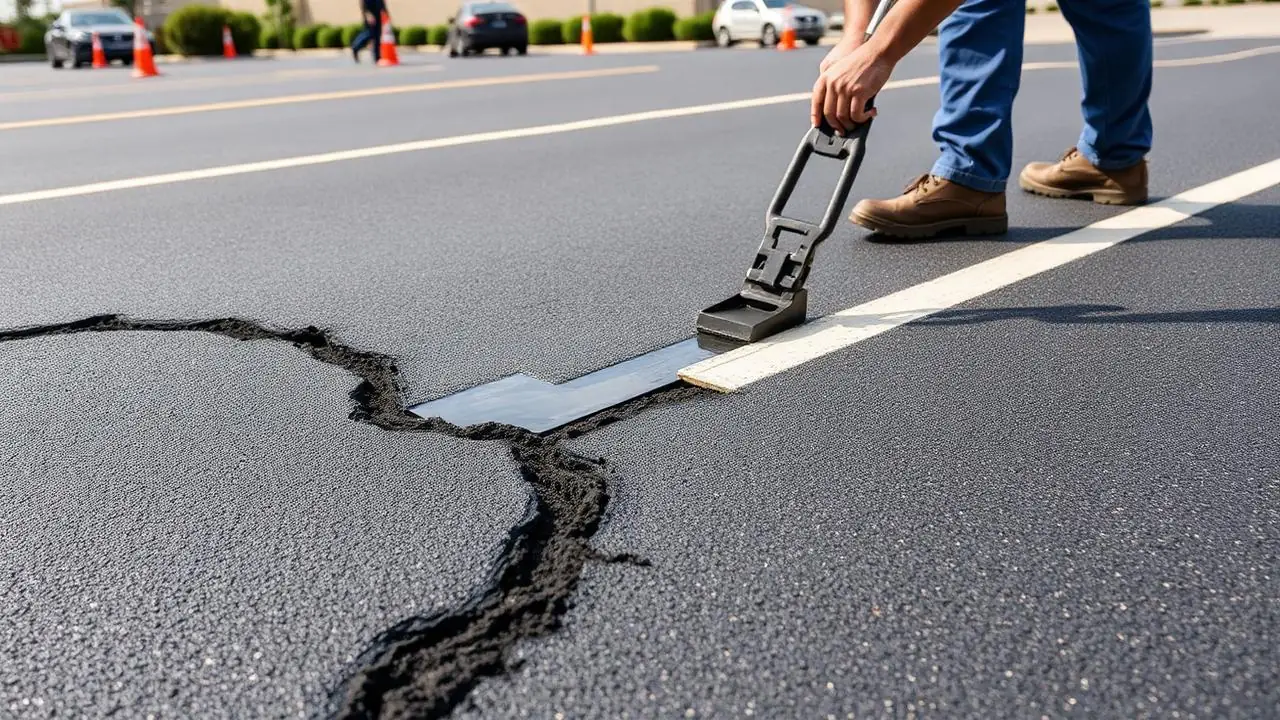
Crack sealing is the process of cleaning out cracks in asphalt pavement and filling them with a hot-applied, rubberized polymer sealant that bonds to the crack walls and stays flexible through freeze-thaw and temperature cycles. The goal is simple: keep water out of the base. Once water gets under your pavement, freeze-thaw and traffic loading turn cracks into potholes, and potholes into base failures.
Crack sealing is one of the highest-ROI maintenance activities you can perform on a commercial pavement. Industry studies and FHWA documentation consistently show that timely crack sealing extends pavement life by 3 to 5 years and dramatically reduces lifecycle cost compared to letting cracks go and patching the resulting damage.
The window for crack sealing matters. Cracks that are still narrow, clean, and bonded to a sound base are perfect candidates. Cracks that have widened past about an inch, that are alligatored (interconnected web patterns), or that have spalled edges are signaling base failure, and need to be patched, not sealed.
Signs your pavement needs crack sealing
- Linear cracks (transverse or longitudinal) wider than ⅛" but narrower than 1"
- Cracks that have not yet alligatored or spalled
- Visible water staining or vegetation growing in cracks
- Cracks appearing 12 to 24 months after sealcoating
- An upcoming sealcoat or restripe project. Seal cracks first
- It has been more than 18 months since the last crack treatment
Our crack sealing process
See our full process- 1
Crack inspection & mapping
We walk the lot and identify which cracks are sealing candidates and which signal base failure that needs patching. Both lists end up in your written scope.
- 2
Cleaning & drying
Cracks are blown out with high-pressure compressed air (and heat lances when conditions require) to remove dust, debris, and moisture. Sealant will not bond to a wet or dirty crack. Period.
- 3
Routing (where applicable)
Selected cracks are routed to a uniform reservoir, which dramatically improves sealant performance and service life. This is an extra step many crews skip and we don't.
- 4
Hot-applied sealant installation
ASTM D6690-compliant rubberized sealant is heated to manufacturer-specified application temperature and installed using a wand or shoe applicator for a uniform overband.
- 5
Finishing
Excess sealant is squeegee'd flush, and a light dusting of sand or toner is applied so the sealant doesn't track in summer heat.
- 6
Documentation
Linear footage sealed, materials used, and before/after photos are filed in your job folder.
What makes Austin Pavement Co. different
We use only Austin-compliant materials. See our compliance standards.
ASTM D6690-compliant materials
We use only sealants that meet ASTM D6690, the standard FHWA-aligned spec for hot-applied crack sealants.
Clean & dry prep discipline
Sealant only works when the crack walls are clean and dry. We don't take shortcuts on prep, even when it slows the job down.
FHWA-aligned process
Our crews are trained on FHWA crack treatment best practices. Routing, application temperature, overband geometry, and finishing.
Photo documentation
Linear feet sealed, materials used, and before/after photos filed with you on every job.
Most contractors disappear after they cash the check. We don't.
Every project is backed by a 12-month workmanship warranty. If a defect in our application shows up in the first year, we come back and fix it, no cost, no runaround.
Crack sealing FAQ
Crack Sealing & Crack Repair across the Austin metro
We deliver crack sealing & crack repair in every city we serve. Choose your area for local details.
Seal cracks now. Patch potholes later.
Free aerial assessment, condition report, and quote, no obligation.
Related services
Commercial Sealcoating
Crack seal first, sealcoat second, the right order for a pavement that lasts.
Read about Commercial SealcoatingAsphalt Repair
When cracks have widened past sealing, saw-cut patching restores the structure.
Read about Asphalt RepairPavement Maintenance Programs
Multi-year plans that schedule crack treatment on the right interval.
Read about Pavement Maintenance Programs