
Most parking lot maintenance starts with a contractor walking your lot for ten minutes, eyeballing the surface, and sending you a quote. You get a number. You don't get context, no documentation of what they saw, no explanation of what's urgent versus what can wait, no way to compare their assessment to anyone else's.
A pavement condition assessment is the opposite of that. It's a documented evaluation of your lot's actual condition, with photos, measurements, condition scoring, and prioritized recommendations, that gives you the information you need to make a smart decision about what to do, when to do it, and how much to budget.
What's included in an assessment
A proper pavement condition assessment covers your entire lot and produces a report that includes:
Condition documentation
Every section of your lot is photographed and evaluated. The report documents specific conditions found. Cracking (type, width, and location), surface deterioration, drainage issues, pavement failures, faded or missing markings, and any ADA/TAS compliance gaps.
This isn't a general observation like "the lot needs work." It's specific: "The southeast section of the main drive lane has alligator cracking across approximately 200 square feet, indicating localized base failure."
Specific documentation serves two purposes. First, it tells you exactly what you're dealing with. Second, it creates a baseline record of your lot's condition at a point in time. Useful for tracking deterioration, supporting budget requests, and demonstrating maintenance diligence if liability questions arise.
Condition scoring
Each section or zone of your lot receives a condition score, typically on a 1-to-10 scale, based on the type and severity of distress observed.
A lot scoring 2–3 has minor surface wear and is in the maintenance window. A lot scoring 5–6 has significant cracking and early structural issues requiring targeted repair. A lot scoring 8–9 has widespread failure requiring resurfacing or reconstruction.
Scoring matters because it removes ambiguity from the conversation. "Your lot needs sealcoating" is a contractor's opinion. "Your lot scores a 4.2 overall, with the main drive lane at 6.1 and the parking sections at 3.5" is a data point that any property manager, board member, or ownership group can evaluate objectively.
Issue prioritization
Not everything needs to happen at once. A good assessment separates issues into priority tiers:
Immediate (safety or rapid deterioration): Potholes in traffic areas. Trip hazards at pedestrian crossings. Missing or illegible ADA markings. Standing water creating hydroplaning risk.
Near-term (this maintenance cycle): Active cracking that's allowing water infiltration. Surface oxidation that's progressed to aggregate exposure. Faded striping that's becoming difficult to read.
Planned (next maintenance cycle): Areas with early-stage deterioration that will need attention in one to two years but aren't urgent today.
This prioritization is what turns an assessment into a decision-making tool. Instead of a contractor saying "your lot needs $40,000 in work," you see: "$5,000 in immediate safety repairs, $22,000 in this-cycle maintenance, and $13,000 in planned work for next year."
Maintenance recommendations with pricing
Each prioritized item comes with a specific recommendation, not just "sealcoat the lot" but "sealcoat the 35,000 SF parking area (two coats, asphalt emulsion, Austin-compliant product), crack seal approximately 450 linear feet of cracking in the drive lanes, and restripe all markings including ADA/TAS compliance corrections."
Recommendations include estimated quantities, proposed materials and methods, and price ranges so you can build a real budget, not a guess.
How an assessment is performed
The assessment process has two components:
Aerial and remote evaluation
For commercial properties, satellite and aerial imagery provides context that a ground-level walk can't. Lot dimensions, drainage patterns, overall surface condition visible from above, and property access points.
On-site evaluation
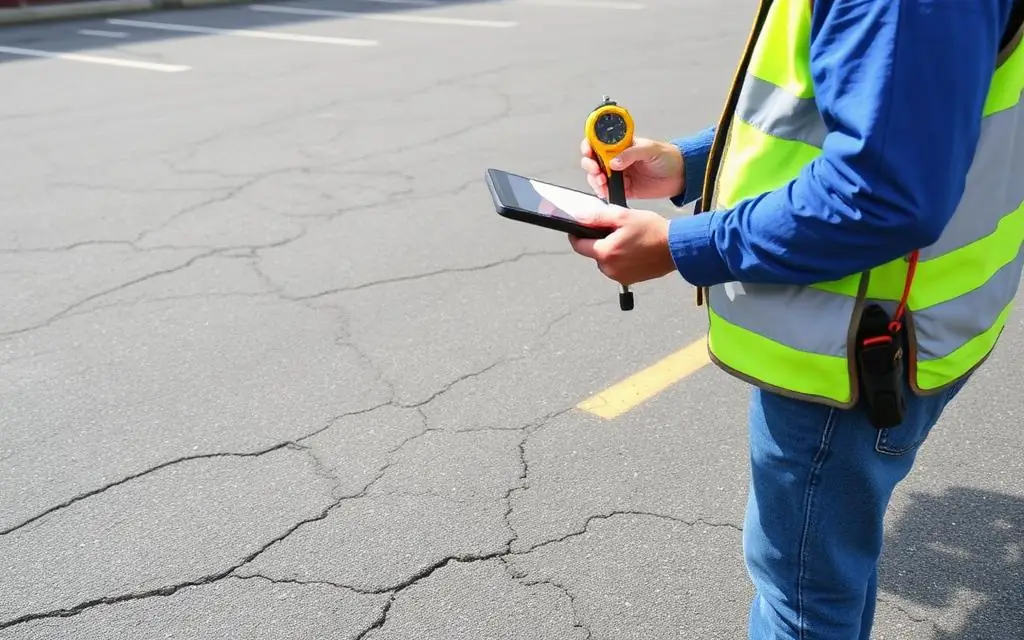
The on-site walk covers every section of the lot and documents conditions with photographs. The evaluator is looking at: surface condition, cracking, structural issues, drainage, markings condition, and site access factors.
The on-site visit typically takes 30 minutes to an hour depending on lot size and complexity. It doesn't require any lot closure or tenant notification.
Why assessments matter for budget conversations
If you've ever tried to get a parking lot maintenance budget approved by a board or ownership group, you know that "the contractor says we need this" isn't a compelling argument. Decision-makers want data, not opinions.
A pavement condition assessment transforms the conversation:
Instead of: "Our parking lot contractor recommends sealcoating this year at a cost of $18,000."
You present: "Our lot was assessed at a 4.8 overall condition score, with the main drive lane at 6.2 indicating active base deterioration. The assessment identifies $4,200 in immediate safety repairs, $14,000 in recommended maintenance this cycle, and $6,000 in planned work for next year. The cost of deferring is estimated at $45,000–$60,000 in overlay costs within 3–4 years."
The second version gets approved because it demonstrates a systematic evaluation, quantifies the risk of deferral, and gives the decision-maker a clear framework for action.
Why assessments matter for liability
Every commercial property manager carries the risk that someone will trip, fall, or damage a vehicle in their parking lot, and that the resulting claim will reference the lot's condition as a contributing factor.
A documented pavement condition assessment creates two pieces of your liability defense:
Evidence of proactive management. An assessment shows you were aware of your lot's condition and took systematic steps to identify and address hazards.
Prioritized response documentation. If a hazard identified in the assessment caused an incident before it was repaired, the assessment's priority classification and your planned response timeline demonstrate that you were acting reasonably.
What a good assessment is not
It's not a sales pitch. An assessment should document conditions objectively, not exaggerate problems to justify a larger scope of work.
It's not a five-minute walkthrough. A contractor who spends ten minutes on your lot, doesn't take photos, and sends you a proposal the same afternoon hasn't performed an assessment. They've given you a bid based on a glance.
It's not just a number. "Your lot needs $25,000 in work" isn't an assessment. It's a price without context. An assessment tells you *what* needs to be done, *why*, *when*, and *what happens if you don't.*
Get yours. Free, no obligation
We provide free pavement condition assessments for commercial properties across the Austin metro. The assessment includes aerial and on-site evaluation, condition scoring, photo documentation, prioritized recommendations, and pricing.
No cost. No obligation. No pressure. You get a documented report whether you hire us or not.
Want this assessed on your property?
We'll send a documented condition report and quote, within 1 business day, no cost.
Get a free assessment →Field notes from the Austin Pavement Co. operations and compliance team, written for property managers, owners, and facilities teams responsible for commercial pavement.