Property managers hear "crack filling" and "crack sealing" used interchangeably. Contractors sometimes use them interchangeably too. But they're different methods with different materials, different costs, and significantly different outcomes, and choosing the wrong one for your situation means either overspending or underfixing.
Here's how to tell them apart and know which one your lot actually needs.
The fundamental difference
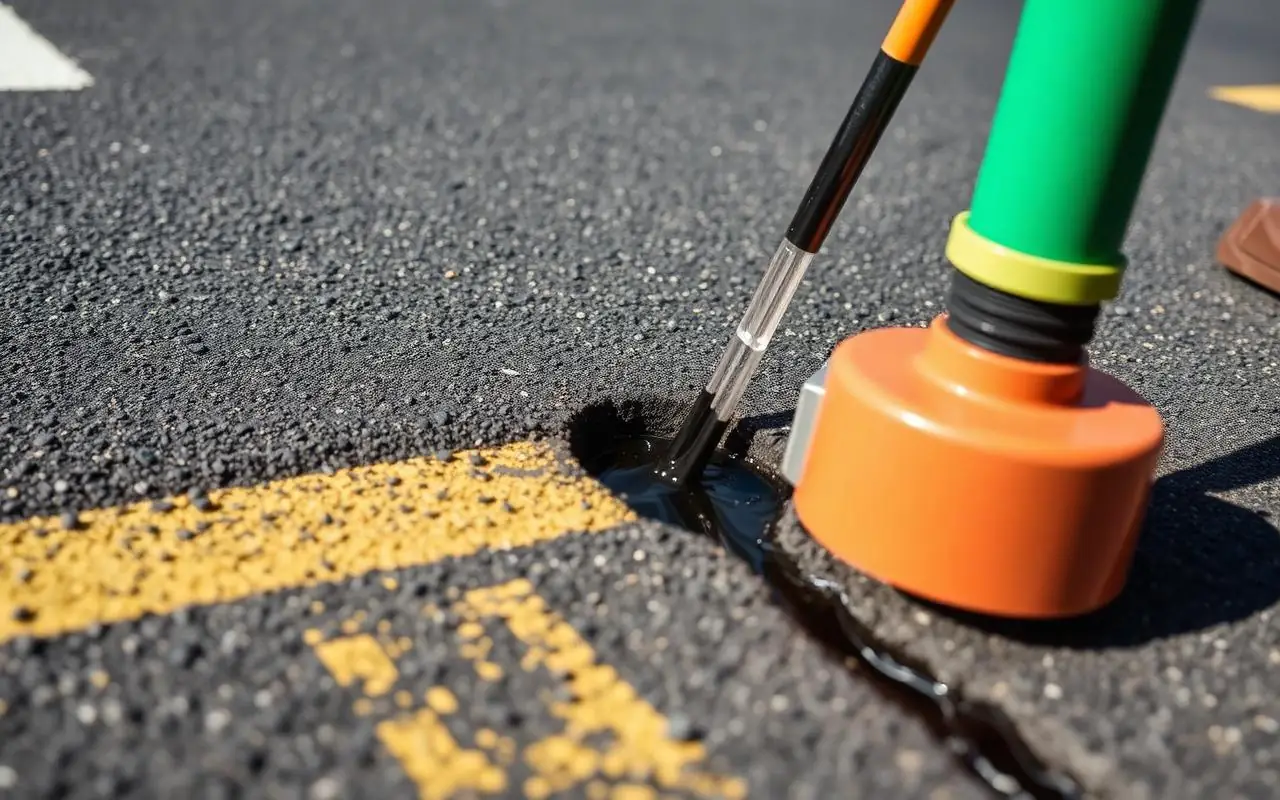
Crack filling is the simpler, less expensive method. It involves cleaning a crack and dispensing a filler material into it, typically a cold-pour rubberized asphalt product or a hot-pour asphalt cement. The material fills the void and reduces water infiltration. It's applied directly into the existing crack without any modification to the crack channel itself.
Crack sealing is a more involved, more durable method. It typically includes routing or sawing the crack to create a uniform reservoir (a consistent channel shape), thoroughly cleaning and drying the crack channel, and then placing a hot-applied sealant, usually one that meets ASTM D6690 specifications, into the prepared reservoir. The sealant bonds to the prepared sidewalls and flexes with pavement movement.
The key distinction is preparation. Crack filling puts material in the crack as-is. Crack sealing creates an engineered reservoir, cleans it to bare surfaces, and places a flexible sealant designed to move with the pavement.
Why preparation matters more than material
The Federal Highway Administration's manual on crack sealing and filling, which is the most comprehensive technical reference on this topic, frames the entire operation around one principle: the material can only bond and perform if the crack channel is clean and dry.
That sounds obvious, but it's where most crack treatment fails. A crack that looks like a simple line on the surface is actually filled with dirt, debris, loose asphalt fragments, moisture, and vegetation. Dispensing sealant on top of that debris doesn't create a bond. It creates a plug that eventually pops out or separates from the crack walls as the pavement moves.
Proper crack sealing addresses this with a defined process: routing to create a consistent channel, compressed air or mechanical cleaning to remove debris and fragments, heat lancing or hot air blasting to dry the channel and warm the surfaces, and then placing the sealant into a prepared, dry, bonding-ready surface.
Crack filling skips most of these steps. It can work for the right applications (more on that below), but understanding the preparation difference explains why crack sealing lasts two to four times longer in most conditions.
When crack filling makes sense
Crack filling is appropriate in specific situations where the lower cost and faster application are justified:
Low-traffic areas with non-working cracks. "Non-working" cracks are those that experience minimal horizontal movement. They don't open and close significantly with temperature changes. These are typically found in stable pavement sections that aren't subject to heavy structural loading or extreme thermal cycling.
Budget-constrained maintenance on lots approaching end of life. If a lot is five to seven years from resurfacing or reconstruction, investing in full crack sealing may not deliver a return. Crack filling can extend service life enough to bridge to the planned major work without the higher per-linear-foot cost of sealing.
Minor surface cracks under a quarter inch. Very small cracks often respond adequately to filling because they don't have significant movement and the void volume is small. These cracks are candidates for a rubberized cold-pour product applied with minimal prep.
Rapid maintenance before sealcoating. When cracks need to be addressed before a sealcoat application and the cracks are relatively minor, filling is often the practical choice. The sealcoat itself provides additional surface protection over the filled cracks.
When crack sealing is the right investment
Crack sealing makes sense when the cracks are significant enough that long-term performance justifies the higher cost:
Working cracks in active pavement. "Working" cracks move with temperature changes. They widen in cold weather and narrow in warm weather. These are the cracks that destroy pavement bases because every expansion-contraction cycle pumps water deeper into the structure. A flexible, well-bonded sealant placed in a routed reservoir accommodates this movement. Rigid crack filler doesn't.
Commercial lots where water infiltration is the primary threat. In Central Texas, the most common cause of serious parking lot failure isn't surface wear. It's water penetrating through cracks to the base layer, weakening the subgrade, and creating voids that lead to potholes and structural failure. Crack sealing is specifically designed to prevent this. If your lot has cracking and you're trying to avoid a $200,000 resurfacing job, proper crack sealing at $5,000 to $15,000 is the highest-return maintenance investment you can make.
Lots with five or more years of remaining service life. The incremental cost of crack sealing over crack filling is typically 40–60% more per linear foot. But sealed cracks last two to four times longer, which means over a five-year maintenance cycle, sealing often costs less per year of protection than filling does.
Cracks wider than a quarter inch. Once cracks reach this width, they're experiencing meaningful movement and water infiltration. Filling these cracks provides temporary cosmetic improvement but rarely prevents continued deterioration. Sealing with a hot-applied, flexible material in a routed reservoir is the appropriate treatment.
The quality markers to look for in either method
Whether your lot gets crack filling or crack sealing, certain quality markers separate competent work from work that fails within a year.
Cleaning is not optional. Even crack filling benefits from compressed air cleaning to remove loose debris. If your contractor is dispensing material into visibly dirty cracks with no cleaning step, the material won't bond and will fail prematurely. For crack sealing, the FHWA is explicit: the objective is a "clean, dry crack channel" free of loosened fragments.
Material selection should be deliberate. For hot-applied crack sealants, ASTM D6690 is the widely referenced standard specification. Materials meeting this standard are designed for use in asphalt pavement cracks and joints, with defined performance properties including adhesion, flexibility, and temperature resistance. Your contractor should be able to tell you what product they're using and what spec it meets.
Application temperature matters. Hot-applied sealants must be heated to a specific application temperature and applied within a defined range. Overheating degrades the material's flexibility. Underheating prevents proper flow and bonding. A contractor using a proper melter/applicator with temperature controls is working correctly. A contractor heating material in an improvised setup is gambling.
Placement configuration is a design choice, not an accident. The FHWA identifies four major configuration types: flush fill, reservoir, overband, and combination. Each has appropriate applications. Flush fill (material dispensed level with the surface) works for filling applications. Overband (a band of sealant extending slightly over the crack edges onto the pavement surface) provides additional sealing area but can be tracked by vehicles. Reservoir configurations (material placed in a routed channel) are the most durable for working cracks. Your contractor should be making this choice deliberately based on your lot's conditions, not just using whatever method is fastest.
What to ask your contractor
When you get quotes for crack treatment, these questions help you distinguish between contractors who understand the work and those who are guessing:
"Is this crack filling or crack sealing, and why?" A knowledgeable contractor will explain which method they're recommending and why it's appropriate for your specific cracks.
"What material are you using?" You should get a product name, manufacturer, and either a spec reference (like ASTM D6690 for hot-applied) or a clear description of the material type.
"How will you prepare the cracks before treatment?" The answer should include, at minimum, cleaning with compressed air. For crack sealing, it should include routing and heat lancing or drying.
"What's the expected service life of this treatment?" Crack filling typically lasts one to three years. Crack sealing in a routed reservoir typically lasts three to eight years depending on conditions and traffic. A contractor who can't answer this question or who promises unrealistic longevity isn't someone you want on your lot.
The bottom line
Crack filling and crack sealing are both valid maintenance treatments, for different situations. The mistake isn't choosing one over the other. The mistake is choosing without understanding the difference, or hiring a contractor who doesn't know the difference themselves.
For commercial properties in Austin where pavement longevity and water intrusion prevention are priorities, crack sealing is typically the better investment for any crack wider than a quarter inch on a lot with meaningful remaining service life. For minor surface cracking or lots approaching end-of-life, crack filling is a practical, cost-effective choice.
Want this assessed on your property?
We'll send a documented condition report and quote, within 1 business day, no cost.
Get a free assessment →Field notes from the Austin Pavement Co. operations and compliance team, written for property managers, owners, and facilities teams responsible for commercial pavement.