Every property manager has deferred maintenance at some point. The budget is tight, the lot looks "fine," and the sealcoating proposal gets pushed to next quarter. Then next year. Then the year after that.
The problem isn't the decision to wait. The problem is that pavement doesn't wait with you. Every month of deferred maintenance accelerates deterioration in ways that aren't visible until the repair bill is five to ten times what the maintenance would have cost.
Here's the math that most contractors won't walk you through, because most contractors benefit from you waiting until the lot needs major work.
The deterioration curve isn't linear
Pavement doesn't age the way most assets do. It doesn't decline gradually from "new" to "worn out" at a constant rate. It follows a curve that's relatively flat for years and then drops off sharply once the surface protection fails.
The lifecycle looks roughly like this:
Years 0–3 (post-install or post-sealcoat): The asphalt surface is protected by its binder or sealcoat layer. UV, water, and chemical exposure are degrading that protection, but the underlying pavement structure is insulated. Maintenance cost in this phase: near zero beyond sweeping and minor crack attention.
Years 3–5 (protection declining): The surface layer is visibly fading and minor cracking is appearing. Water is beginning to reach the pavement structure through hairline cracks. This is the optimal window for sealcoating and crack treatment. Cost of intervention: $0.15–$0.30 per square foot for sealcoating plus $2–$5 per linear foot for crack sealing.
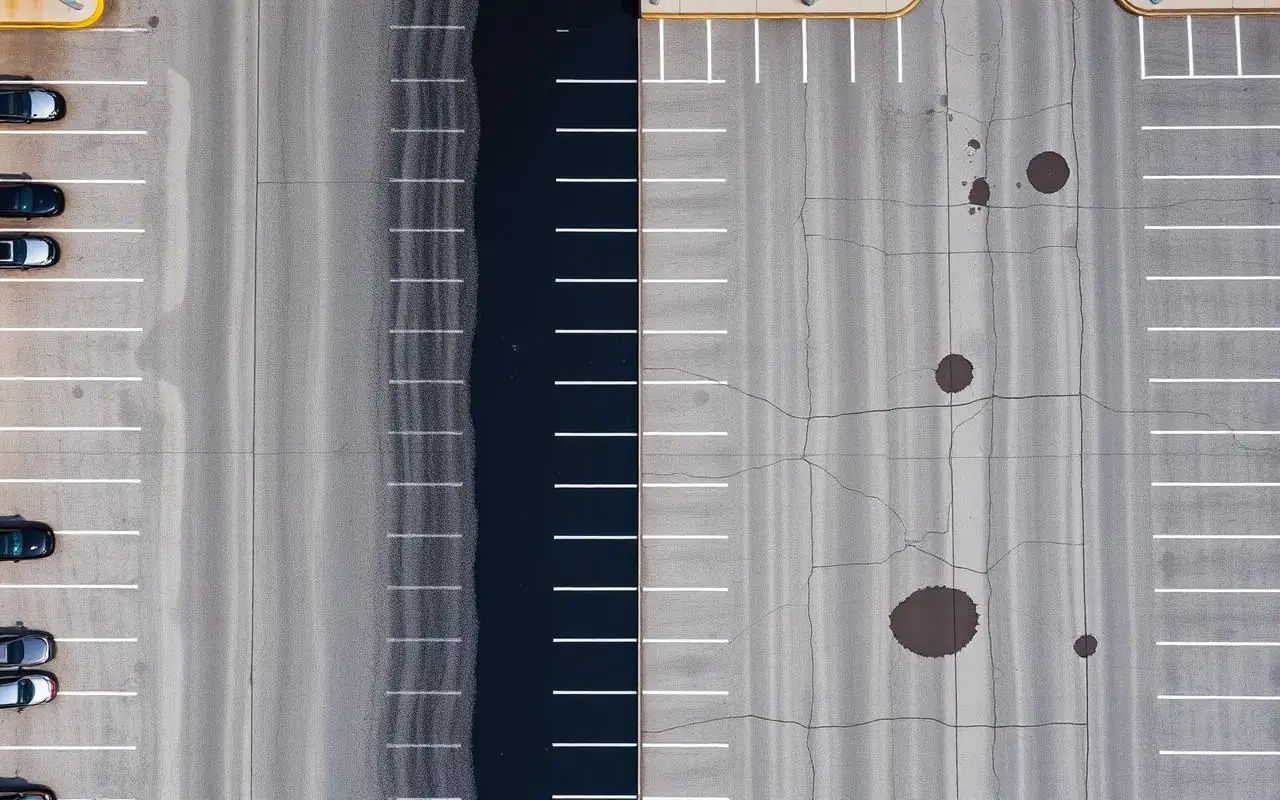
Years 5–8 (accelerating deterioration): Without maintenance, UV has fully oxidized the surface binder. Cracks have widened. Water is reaching the base layer with every rain event. In Austin's climate, hot summers followed by periodic heavy rain, this water infiltration is actively eroding the base material and weakening the subgrade. The lot still looks "driveable" but the damage underneath is compounding. Cost of intervention now: same sealcoating and crack treatment cost, plus $3–$8 per square foot for localized asphalt repair on sections where base failure has begun.
Years 8–12+ (structural failure): Potholes form. Sections of pavement crack into "alligator" patterns indicating base failure. Water pools in depressed areas. The lot is beyond surface maintenance. It needs structural repair, overlay, or full reconstruction. Cost: $4–$7 per square foot for a mill-and-overlay, or $7–$12+ per square foot for full removal and replacement.
The cost difference between maintaining and not maintaining isn't 20% or 50%. It's 500% to 1,000%.
A real-world comparison
Consider a 40,000-square-foot commercial parking lot, a mid-sized retail center or office park lot in Austin.
Scenario A: Maintained on schedule
| Year | Activity | Approximate cost |
|---|---|---|
| Year 2 | Crack seal (200 LF) + sealcoat + restripe | $8,500 |
| Year 5 | Crack seal (300 LF) + sealcoat + restripe | $9,200 |
| Year 8 | Crack seal (350 LF) + sealcoat + restripe | $9,800 |
| Year 10 | Minor patching (500 SF) + crack seal | $4,500 |
| Year 12 | Sealcoat + restripe | $7,800 |
| Total over 12 years | ~$39,800 |
Pavement condition at year 12: good. Surface protected. Base intact. Another 8–10 years of service life with continued maintenance.
Scenario B: Maintenance deferred
| Year | Activity | Approximate cost |
|---|---|---|
| Years 1–7 | Nothing | $0 |
| Year 8 | Emergency pothole repair (reactive) | $3,500 |
| Year 9 | More potholes, tenant complaints, patching | $6,200 |
| Year 10 | Base failure spreading, major patching | $12,000 |
| Year 12 | Mill and overlay required | $200,000–$280,000 |
| Total over 12 years | ~$225,000–$300,000 |
Pavement condition at year 12 (pre-overlay): failed. After overlay: reset to new, but at six to eight times the cost of the maintained scenario.
These numbers aren't hypothetical. They're built from real Austin-market pricing for the services and conditions described. Your specific lot will vary, but the ratio, maintained costs versus deferred costs, is consistent.
The costs you don't see on the repair invoice
The direct comparison above only captures hard maintenance and repair costs. Deferred maintenance creates several additional costs that don't show up on a contractor's invoice:
Liability exposure. A deteriorated parking lot with potholes, crumbling edges, and faded striping is a trip-and-fall risk. Property managers carry liability for injuries that occur on their lots, and a visibly neglected surface undermines any defense. The cost of a single slip-and-fall claim, even one that's successfully defended, typically exceeds a decade of proactive maintenance.
Tenant satisfaction and retention. Commercial tenants notice their parking lot. Retail tenants notice it acutely because their customers see it first. A deteriorated lot signals neglect to tenants, which affects lease renewal conversations and sometimes rent negotiations. The cost is hard to quantify precisely, but ask any property manager who's lost a tenant and they'll tell you: lot condition was part of the conversation.
Property valuation. For properties that may be sold or refinanced, deferred maintenance reduces appraised value. A lot needing $250,000 in reconstruction is a $250,000 reduction in property value, or more, because buyers and appraisers often discount further for the disruption and uncertainty of major lot work.
ADA/TAS compliance gaps. As striping fades and markings become illegible, your lot drifts out of compliance with accessibility requirements. In Texas, TDLR enforces accessibility standards and can assess penalties against building owners. A lot that hasn't been restriped in years almost certainly has compliance gaps. Faded accessible space markings, illegible fire lane designations, worn access aisle hatching.
Stormwater and environmental risk. A lot with extensive cracking and potholes collects and channels water in uncontrolled ways, potentially concentrating sediment and pollutant runoff. In Austin, where stormwater management is actively regulated, a deteriorated lot surface can create environmental compliance questions that wouldn't exist with a maintained surface.
Why the "wait and see" approach always costs more
The instinct to defer maintenance comes from a reasonable place: if the lot looks fine today, why spend money on it? The answer is that by the time a lot *looks* like it needs work, the damage is already well advanced.
Surface cracking is visible at the 3–5 year mark. But water has been infiltrating through those cracks for months or years before they're obvious. By the time you see a pothole, the base failure that created it has been progressing for a year or more underneath.
Pavement maintenance is one of the clearest examples of the principle that prevention is cheaper than repair. The gap isn't marginal. It's an order of magnitude. A $0.20-per-square-foot sealcoat that prevents $7-per-square-foot reconstruction is a 35:1 return on investment.
What a maintenance program actually looks like
The most cost-effective approach for commercial properties is a documented maintenance program with scheduled activities tied to condition assessment rather than arbitrary calendars. The core components:
Annual inspection and documentation. A walk-through or aerial assessment to document current conditions, identify new cracking, note drainage issues, and photograph problem areas. This creates a record that supports both budgeting and liability defense.
Crack treatment as needed. Cracks don't wait for a convenient schedule. Address them within their first season of appearance, before water has a full rain cycle to work into the base. This is the single highest-return maintenance activity.
Sealcoating every two to three years. Timed based on condition rather than a rigid calendar. When the surface has faded to gray and aggregate is becoming visible, it's time. Regardless of whether it's been two years or three.
Restriping after every sealcoat. Sealcoating covers existing striping, so this is not optional. It's part of the sealcoating project. Use the opportunity to correct any compliance issues in the existing layout.
Budget-cycle alignment. A maintenance program should produce a predictable annual cost that fits your operating budget, not a surprise capital expenditure that requires board approval and disrupts tenant operations.
Start with an assessment
If you're managing a commercial property in Austin and you're not sure where your lot stands on the deterioration curve, that's exactly the situation our free pavement assessment is designed for. We'll evaluate your lot's current condition, document the specific issues, and provide a prioritized maintenance recommendation with realistic pricing, so you can make a data-informed decision about how to protect your investment.
Want this assessed on your property?
We'll send a documented condition report and quote, within 1 business day, no cost.
Get a free assessment →Field notes from the Austin Pavement Co. operations and compliance team, written for property managers, owners, and facilities teams responsible for commercial pavement.