There's a moment in every parking lot's life where the question shifts from "what maintenance does it need?" to "is maintenance even worth it?" Getting that call right saves property managers tens or hundreds of thousands of dollars. Getting it wrong, in either direction, means either wasting money on maintenance that can't fix the underlying problem, or spending six figures on resurfacing a lot that had years of life left with the right care.
Here's how to read your lot's condition and make that decision with confidence.
The three zones of parking lot condition
Every parking lot falls into one of three condition zones, and the right treatment depends entirely on which zone yours is in.
Zone 1: Maintenance territory
What you see: Uniform surface fading from black to gray. Hairline surface cracking (cracks under a quarter inch). Intact surface texture. Striping is faded but visible. No standing water in normal rain. No potholes.
What it means: The surface protection has worn off, but the pavement structure, the asphalt layer and the base beneath it, is intact.
What it needs: Crack sealing on any visible cracks, followed by a two-coat sealcoat application and fresh striping. Total cost: typically $0.18–$0.32 per square foot.
Expected outcome: Five to eight more years of service life with continued maintenance cycles.
Zone 2: The gray area. Heavy maintenance or minor resurfacing
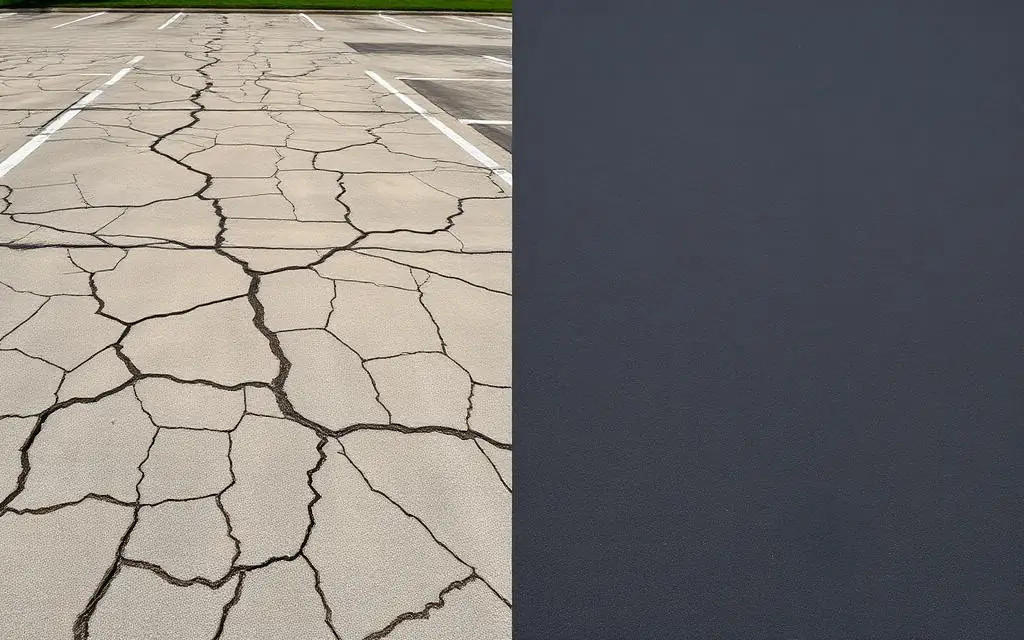
What you see: Cracking that's widespread and includes some cracks wider than a quarter inch. Some "block" or "map" cracking patterns. Isolated areas of alligator cracking. A few potholes or depressions, typically near drains or at lot edges. Some standing water after rain in localized areas.
What it means: Water has been infiltrating through cracks long enough to begin weakening the base in some areas, but the damage isn't lot-wide.
What it needs: This is where judgment matters most. The right approach is usually a combination strategy: saw-cut and patch the failed sections, crack seal the remaining cracks, then sealcoat and restripe the entire lot.
This "patch and preserve" approach addresses the structural failures where they exist while preserving the majority of the lot that's still sound. Total cost: typically $1.50–$4.00 per square foot.
When this zone tips into resurfacing territory: If the failed areas exceed roughly 25–30% of the lot's total area, the cost of patching approaches the cost of an overlay.
Zone 3: Resurfacing or reconstruction
What you see: Widespread alligator cracking across large sections or the majority of the lot. Multiple potholes forming and recurring even after repair. Visible base material showing through failed asphalt. Significant depressions or rutting. Standing water across broad areas. Pavement that "pumps" when heavy vehicles drive over it.
What it means: The pavement structure has failed. The base layer is compromised, and the asphalt surface can no longer be maintained.
What it needs: One of two approaches.
Mill and overlay removes the top layer of existing asphalt, repairs any base damage, and installs a new asphalt surface. Cost: typically $4–$7 per square foot.
Full reconstruction removes all existing asphalt, excavates and rebuilds the base, and installs new asphalt. Cost: typically $7–$12+ per square foot.
How to tell which zone your lot is in
The visual cues above will get you most of the way, but two additional diagnostic steps help:
The screwdriver test for cracking severity. Insert a flathead screwdriver into the widest cracks. If it penetrates less than an inch, the cracking is surface-level (Zone 1 or early Zone 2). If it penetrates more than 1.5 inches easily, the crack extends through the full asphalt layer (Zone 2 or 3).
The puddle map after a moderate rain. Walk your lot 30 minutes after a steady rain and note where water is standing. Isolated puddles are normal. Broad areas of standing water indicate base settlement (Zone 2–3). Water seeping up through cracks means the base is saturated (Zone 3).
The financial decision framework
How many years of service life do you need?
If you're holding the property for 10+ more years, investing in proper maintenance or an overlay makes sense. If you're planning to sell within 3–5 years, weigh whether a full resurface improves the sale price by more than it costs.
What does your tenant situation demand?
A retail property where lot appearance directly affects tenant revenue may justify an overlay at the Zone 2 stage. An industrial property with tenants who care more about function can extend the patch-and-preserve approach further.
What's the reconstruction cost versus the remaining value of maintenance?
Run the actual numbers. A patch-and-preserve approach might cost $100,000 and buy you five to seven years. An overlay might cost $250,000 and buy you twelve to fifteen years. Per year of service life, they're often close, and the decision tips on cash flow timing and tenant requirements.
Austin-specific considerations
Expansive clay soils. Austin sits on various clay formations that expand when wet and contract when dry. If your lot's cracking patterns follow lines rather than networks, soil movement may be the driver. An overlay without addressing the subgrade just puts a new surface on the same unstable foundation.
Growth-driven traffic increases. If your property has added tenants or seen traffic volumes increase significantly, the original pavement section may be undersized for current loads. An overlay that adds structural thickness can be a better investment than maintenance.
The mistake to avoid
The biggest mistake property managers make isn't choosing wrong between maintenance and resurfacing. It's avoiding the decision entirely. Deferring all action until the lot forces their hand with potholes, tenant complaints, or a liability incident.
A lot in Zone 1 that gets maintained stays in Zone 1 indefinitely. A lot in Zone 2 that gets a targeted patch-and-preserve treatment can be kept in Zone 2 for years. But a lot in Zone 2 that gets nothing will reach Zone 3 within two to four years, and the cost jumps by 400–700%.
The decision is never between "spend money now" and "spend nothing." It's between "spend this much now" and "spend five times as much later."
Get a professional assessment
If you're not sure which zone your lot is in, or if you're in the gray area and need help making the financial case, we can help.
Want this assessed on your property?
We'll send a documented condition report and quote, within 1 business day, no cost.
Get a free assessment →Field notes from the Austin Pavement Co. operations and compliance team, written for property managers, owners, and facilities teams responsible for commercial pavement.