Fire lanes are the most heavily regulated markings on a commercial parking lot, and the ones most likely to fail an inspection. Austin Fire Department (AFD) enforces fire lane requirements under the City of Austin's adopted edition of the International Fire Code (IFC), and a non-compliant fire lane can trigger correction orders, fines, and certificate-of-occupancy holds on tenant turnover.
This guide covers what fire lane striping actually has to look like on the ground in Austin: paint color, lettering, curb marking intervals, signage, and the inspection points that catch property managers off guard.
Who enforces fire lane requirements in Austin
Three layers of rules apply to commercial fire lanes in Austin:
The International Fire Code (IFC), adopted by the City of Austin with local amendments, establishes the baseline. IFC Section 503 governs fire apparatus access roads, including width, marking, and signage requirements.
The Austin Fire Department (AFD) enforces the adopted code through plan review, new-construction inspections, and complaint-driven inspections on existing properties. AFD's Engineering Services group reviews site plans and confirms fire lane layouts during construction; field inspectors verify markings remain compliant over time.
Your site's approved fire lane plan, recorded with the city at the time of construction or major alteration, controls the specific layout for your property. The painted fire lanes on your lot must match what's on file. Repainting in a different location or in a different configuration without an updated plan is a code violation even if the new layout would otherwise comply.
If you're not sure where your approved fire lanes are, the recorded site plan from your project's permit file is the authoritative reference.
Curb color: red, and a specific red
Fire lane curbs in Austin must be painted red. That part is well known. What trips people up is the shade.
AFD inspectors expect a true traffic-grade fire-lane red, not a faded brick, not a maroon, and not an orange-leaning red. In practice that means a high-visibility red traffic paint formulated for pavement and curb marking, applied at full coverage with no bleed-through from previous coats. A common reference is Federal Standard 595 color 11105 (the bright "fire red" used for fire apparatus and fire lane curbs nationally), and most reputable traffic-paint manufacturers sell a "fire lane red" SKU that matches this expectation.
The practical implication for property managers: when a fire lane is repainted, the color has to actually look red under daylight inspection. A faded, oxidized, or under-coated curb is a deficiency even if the original paint was the correct shade. AFD inspectors will document a fire lane curb that has faded to pink, orange, or brown and require it to be repainted.
"NO PARKING FIRE LANE" lettering
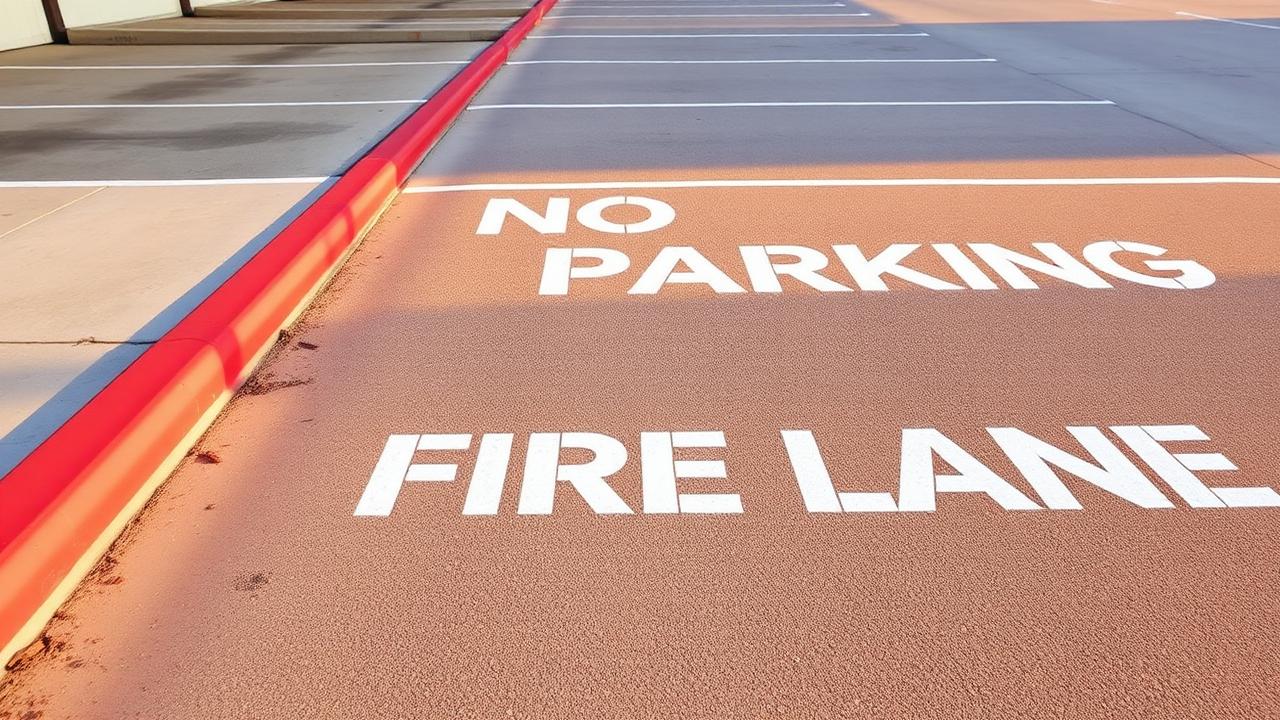
The text marking on the curb (and on the pavement where required) has to be legible to the average driver from inside a vehicle. The IFC requires fire apparatus access roads to be marked, and Austin's standard practice is white "NO PARKING FIRE LANE" lettering applied directly to the red curb face.
The accepted standard for lettering on the curb face is:
- Letter height: 3 inches minimum on the curb face. Many properties use 4 inch lettering for better visibility. - Stroke width: roughly 1/2 inch, proportional to letter height, using a standard block or stencil font. - Color: white, using a traffic-grade paint that contrasts with the red curb at full coverage. - Spacing along the curb: the lettering should repeat along the full length of the fire lane so that it's visible from any parking position. The widely used interval is no more than 25 feet between repetitions, and many AFD-reviewed plans specify 20 feet to be safe.
Where a fire lane runs along a section of pavement with no adjacent curb (for example a striped fire lane through a drive aisle), "NO PARKING FIRE LANE" lettering is painted directly on the asphalt in white block letters typically 18 to 24 inches tall, repeated at no more than 50 foot intervals along the lane.
Striping the lane itself
Where a fire lane is delineated on pavement (rather than only by a marked curb), the lane edges are striped with continuous solid lines. Common practice:
- Line color: yellow or white, depending on the approved site plan. Yellow is most common for fire lanes. - Line width: 4 inches minimum, applied as a solid continuous line. - Lane width: the lane itself must remain unobstructed to the width specified on the approved plan. The IFC baseline for fire apparatus access is 20 feet of unobstructed width, with greater widths required when buildings exceed 30 feet in height.
Diagonal hatching is sometimes added inside the fire lane to reinforce the no-parking message, but the controlling rule is the approved plan. Add hatching only if it appears on the plan or if AFD has approved an alteration.
Signage
Striping alone is not enough. Fire lanes must also be posted with signs that read "NO PARKING FIRE LANE" or equivalent language meeting the IFC and Texas Transportation Code.
The standard sign specification used in Austin:
- Sign face: white background with red lettering, or red background with white lettering, in the standard MUTCD-style rectangle. - Letter height: at least 1 inch for the legend, with the primary message readable from a stopped vehicle. - Mounting height: 7 feet from grade to the bottom of the sign in pedestrian areas, and at least 5 feet in parking areas. - Spacing: signs every 50 feet along the fire lane at a maximum, with a sign at each end and at any change in direction.
Signs missing from the ends of a posted fire lane are one of the most commonly cited deficiencies during AFD inspections.
Pavement markings at fire department connections and hydrants
Two specific spots on a commercial lot get additional fire lane treatment, and both are inspection focal points:
Fire department connections (FDC). A clear approach to the FDC must be marked and kept open. The pavement in front of the FDC is typically striped as a no-parking zone with diagonal hatching, and the curb in front is painted red with "NO PARKING FIRE LANE" lettering. The exact extent is set by the approved plan, but a 15 foot no-parking zone on each side of the FDC is a common minimum.
Fire hydrants. The IFC and Texas Transportation Code prohibit parking within 15 feet of a fire hydrant. On a commercial lot, this is enforced visually by painting the curb red for 15 feet on each side of the hydrant and marking the pavement appropriately if there is no adjacent curb. Hydrant clearance markings are a common deficiency on lots that have had striping refreshed without restoring the hydrant zones.
Inspection points that fail most often
The deficiencies AFD inspectors document most frequently on commercial lots in Austin:
Faded red curb paint. The single most common citation. Fire lane red oxidizes quickly under Texas sun, especially on south- and west-facing curbs. Plan to refresh fire lane curbs every 2 to 3 years, in step with your sealcoat and striping cycle.
Missing or worn "NO PARKING FIRE LANE" lettering. Curb lettering wears off faster than the curb paint itself because the white pigment is thinner. Many lots have a freshly painted red curb with illegible or absent lettering, which is still a deficiency.
Signs missing at the ends of the lane. A long posted fire lane often has signs along its length but is missing the terminal sign at one end, which technically leaves the end unmarked.
Hydrant zones not restored after sealcoat or stripe work. When a lot is restriped, the contractor restores parking stalls and fire lane curbs but forgets to repaint the 15 foot no-parking zones flanking each hydrant.
Layout drift from the approved plan. A property manager repaints fire lanes "where they've always been," but the recorded approved plan shows a different configuration. The painted layout has to match the plan on file, not the layout the previous owner used.
Obstructions in the fire lane. Dumpsters, planters, parked maintenance vehicles, and tenant-installed bollards inside a fire lane are deficiencies regardless of the quality of the markings.
How fire lane work fits into a striping project
Fire lane striping should be scoped as a distinct line item in any restriping project, not bundled invisibly into the parking stall count. Specifically:
- Red curb paint is priced by linear foot of curb face, and quality contractors will specify the paint brand and product (for example, SealMaster Fire Lane Red or equivalent fire-lane-grade traffic paint). - "NO PARKING FIRE LANE" lettering is priced per stencil instance, with the interval set to match your approved plan. - Hydrant and FDC clearance markings are scoped individually for each device on the lot. - Signage is replaced as needed, with sign-and-post counts called out separately on the proposal.
If a proposal lumps "fire lane refresh" into a single line item without specifying linear feet, lettering counts, or sign work, ask for the breakdown. That detail is what allows you to confirm the lane will actually be inspection-ready when the crew leaves.
When fire lane work triggers a plan review
Most fire lane repainting is "in-kind" maintenance, restoring existing markings to their approved layout, and does not require a new AFD plan review. However, any of the following changes triggers a plan review with AFD Engineering Services before the work can be performed:
- Moving a fire lane to a new location on the lot. - Reducing the width of an existing fire lane. - Removing a fire lane in response to a building reconfiguration. - Adding a fire lane to serve a newly constructed building or addition. - Relocating a fire department connection or hydrant.
If your property is undergoing a tenant build-out, building expansion, or any change to the building footprint, the fire lane plan typically needs to be reviewed and updated as part of the permit set. Restriping the new configuration before the plan is approved creates a violation that has to be undone.
Documentation to keep on file
Property managers responsible for commercial lots in Austin should keep three documents readily accessible:
The approved fire lane plan for the property, from the permit file.
The most recent striping contractor's scope of work and invoice, showing the specific products applied and the linear footage and lettering counts restored.
Photos of the fire lane immediately after the most recent restripe, dated, showing curb paint, lettering, signage, and hydrant zones. These photos are useful during inspections, insurance reviews, and tenant disputes.
This documentation set lets you respond to an AFD inspection or complaint with a clear record of what was done, when, and to what specification.
Get your fire lanes audited
If you're not sure whether your fire lanes match your approved plan or whether the curb paint and lettering would pass a current AFD inspection, an audit is the right place to start. We document existing fire lane conditions against your recorded plan, identify deficiencies before AFD does, and scope the restoration as a line-item compliance project so you have a clear record of what was corrected.
Want this assessed on your property?
We'll send a documented condition report and quote, within 1 business day, no cost.
Get a free assessment →Field notes from the Austin Pavement Co. operations and compliance team, written for property managers, owners, and facilities teams responsible for commercial pavement.