Parking lot striping looks simple until you get it wrong. And in Texas, getting it wrong means exposure to enforcement under both federal ADA requirements and the state's own Texas Accessibility Standards (TAS), a framework with real penalties administered by the Texas Department of Licensing and Regulation (TDLR).
If you manage commercial property, understanding what's required isn't optional. Here's what you actually need to know.
The two standards that apply in Texas
Texas commercial properties must comply with two overlapping frameworks:
The Americans with Disabilities Act (ADA) establishes federal accessibility requirements, including standards for accessible parking. The ADA Standards for Accessible Design specify the number, dimensions, and features of accessible parking spaces.
The Texas Accessibility Standards (TAS) are the state's accessibility requirements, administered and enforced by TDLR under the Elimination of Architectural Barriers (EAB) program. TAS standards are based on the ADA standards but Texas enforces them independently through its own inspection and penalty process.
Where TAS and ADA differ, the more restrictive standard applies. In practice, TAS generally aligns with ADA for parking, but Texas adds its own enforcement mechanism, meaning violations can trigger state-level penalties against building owners through TDLR.
How many accessible spaces do you need?
The required number of accessible parking spaces is based on the total number of spaces in the lot:
| Total spaces in lot | Required accessible spaces |
|---|---|
| 1–25 | 1 |
| 26–50 | 2 |
| 51–75 | 3 |
| 76–100 | 4 |
| 101–150 | 5 |
| 151–200 | 6 |
| 201–300 | 7 |
| 301–400 | 8 |
| 401–500 | 9 |
| 501–1,000 | 2% of total |
| Over 1,000 | 20, plus 1 for each 100 over 1,000 |
Of the total required accessible spaces, at least one in every six (rounded up) must be van-accessible.
Dimension requirements under TAS
This is where most striping errors happen. TAS specifies precise measurements, and they're taken from the centerline of the markings, not the inside edge.
Standard accessible car spaces: Minimum 96 inches wide (8 feet), measured from centerline to centerline of the boundary markings.
Van-accessible spaces: Minimum 132 inches wide (11 feet) with a 60-inch access aisle. Alternatively, a van-accessible space can be 96 inches wide with a 96-inch access aisle, the wider aisle compensates for the narrower stall.
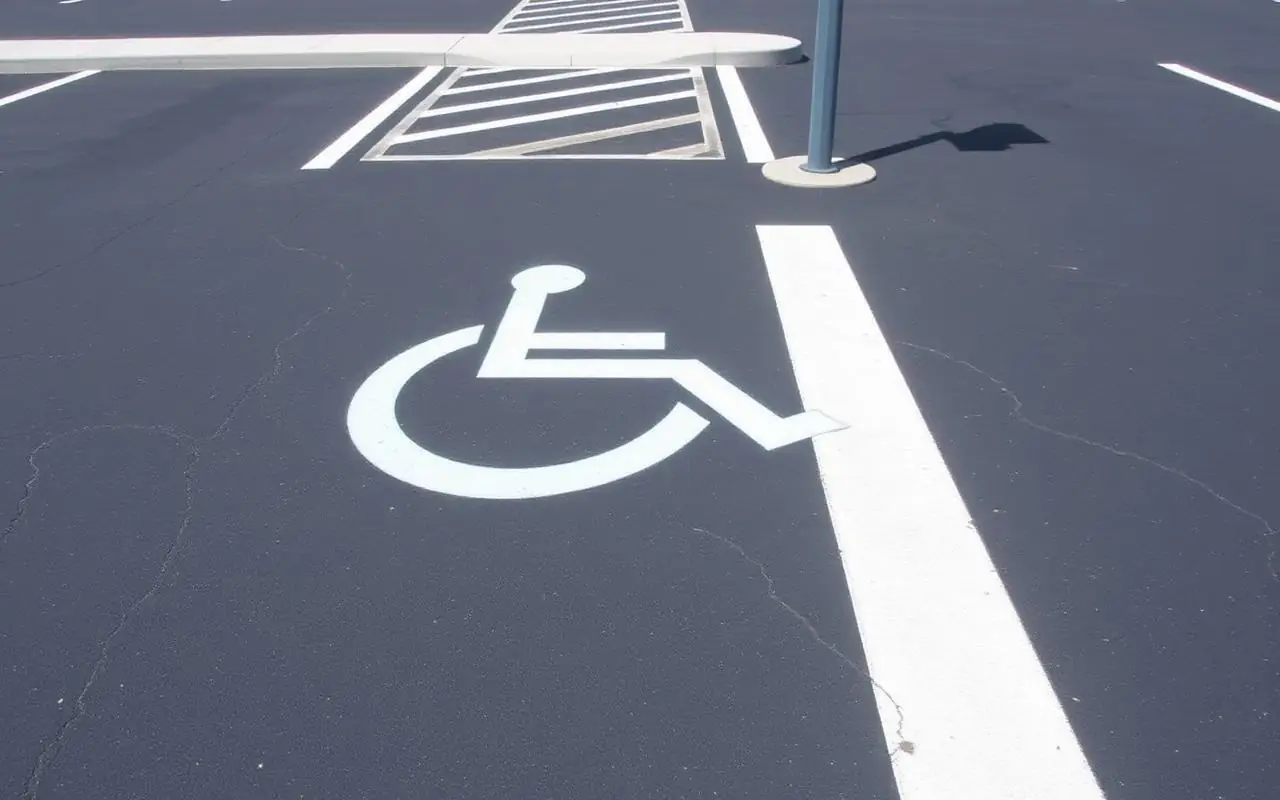
Access aisles: Minimum 60 inches wide. Must be marked (typically with diagonal hatch lines) to discourage parking. Access aisles must be at the same level as the adjacent accessible spaces and connect to an accessible route to the building entrance.
Key measurement note: All dimensions are minimums. If your lot allows wider spaces without reducing total count significantly, wider is better for actual usability.
Signage requirements
Accessible spaces require posted signs, not just painted symbols.
Mounted signs are required. Each accessible space must have a sign with the International Symbol of Accessibility posted so it's visible when a vehicle is parked in the space. This typically means a post-mounted sign, not a ground-level pavement marking alone.
Van-accessible spaces need additional designation. Van spaces must include "Van Accessible" on the sign or on an additional sign below the accessibility symbol.
Sign height matters. Signs must be mounted high enough to be visible over parked vehicles, typically a minimum of 60 inches from the ground to the bottom of the lowest sign.
Fines signage in Texas. Texas law requires that accessible parking signs include information about the maximum fine for illegal parking in an accessible space. The current maximum fine is $1,250 for a first offense.
Ground markings
Beyond the signage, the pavement markings themselves must include:
The International Symbol of Accessibility painted in each accessible space, typically a 36-inch square symbol painted on the pavement within the space.
Access aisle markings. Diagonal hatch lines within the access aisle, clearly indicating that the aisle is not a parking space. These lines serve as a visual deterrent and are functionally important for wheelchair ramp deployment.
Blue is standard but not federally mandated for the pavement symbol. Most jurisdictions expect blue and white for the ISA marking, and blue is the de facto standard. Using non-standard colors invites questions during inspections even if not explicitly prohibited.
When does a restriping project trigger compliance obligations?
This is the question most property managers miss, and where real liability hides.
The U.S. Access Board provides guidance on what constitutes an "alteration" versus routine maintenance. The distinction matters because alterations trigger compliance obligations while routine maintenance generally doesn't.
Projects that are considered alterations (compliance triggered): - Resurfacing or resealing a parking lot - Adding new parking spaces - Changing the layout or configuration of existing spaces - Repaving or overlaying the lot surface
Projects generally considered routine maintenance (compliance not triggered): - Filling potholes - Patching small areas - Repainting existing striping in place without changing the layout, but only if you're repainting the *exact* existing layout for a small number of spaces
The critical nuance: if you're sealcoating your entire lot, that's considered resurfacing, which is an alteration. Once you sealcoat, you're restriping the entire lot from scratch, and that restriping must meet current TAS/ADA requirements, even if the old layout didn't. This catches property managers who assume they can just "paint the lines back where they were." If the existing layout wasn't compliant, reproducing it after sealcoating doesn't protect you.
Common compliance failures we see in Austin lots
Stall width measured incorrectly. The most common error is measuring from the inside edge of markings rather than from centerline to centerline. A 4-inch stripe on each side means your 96-inch centerline-to-centerline space needs about 100 inches of clear space between outside edges of markings, but the legal measurement is centerline-to-centerline.
Access aisles too narrow. Many older lots have access aisles that were originally striped at 48 inches rather than the required 60 inches. If you're restriping after sealcoating, these must be corrected to 60 inches minimum.
Missing van-accessible spaces. Some lots have the correct total number of accessible spaces but lack the required van-accessible designation. At least one in six accessible spaces must be van-accessible with appropriate dimensions and signage.
Signage missing or non-compliant. Painted symbols alone don't satisfy the signage requirement. Each space needs a posted (typically post-mounted) sign visible when a vehicle is parked.
Access aisles not connected to an accessible route. The aisle must provide a direct path to the building entrance. Spaces located where the access aisle dead-ends into a curb with no curb ramp or accessible path technically don't comply, even if the stall dimensions are correct.
Accessible spaces not in the closest available location. Accessible spaces must be located on the shortest accessible route to the building entrance. A compliant space on the far side of the lot doesn't meet the requirement if closer spaces exist.
TDLR enforcement and penalties
TDLR enforces TAS through its Elimination of Architectural Barriers program. The agency publishes penalty ranges and sanction structures for violations, and penalties can be assessed against building owners.
This isn't theoretical. TDLR conducts inspections and responds to complaints. A non-compliant parking lot, particularly after a restriping project that should have brought it into compliance, creates documented enforcement exposure.
The practical risk for property managers: if a tenant, visitor, or advocacy organization files a complaint about your lot's accessibility, TDLR can inspect and assess penalties. The defense of "we didn't know" doesn't hold when the project that triggered compliance obligations was a sealcoating and restriping job you paid for.
How to protect yourself
Require a compliance review as part of any striping project. Before your contractor restripes, they should provide a layout plan that addresses ADA/TAS requirements, not just reproduce whatever was there before.
Keep documentation. A compliant layout plan, photos of the completed work, and a written confirmation from your contractor that the layout meets current TAS/ADA standards gives you a paper trail if questions arise.
Don't separate sealcoating from striping decisions. Since sealcoating triggers restriping and restriping can trigger compliance obligations, treat them as a single project. Evaluate your existing layout compliance *before* the sealcoat goes down, not after when you're under time pressure to reopen the lot.
We build compliance into every striping project
Every parking lot striping project we perform includes a TAS/ADA compliance review as a standard part of our process, not as an add-on. We verify stall counts, dimensions, signage requirements, access aisle widths, and accessible route connections before we paint a single line.
Want this assessed on your property?
We'll send a documented condition report and quote, within 1 business day, no cost.
Get a free assessment →Field notes from the Austin Pavement Co. operations and compliance team, written for property managers, owners, and facilities teams responsible for commercial pavement.